Faithful Stewardship for Fruitful Ministry
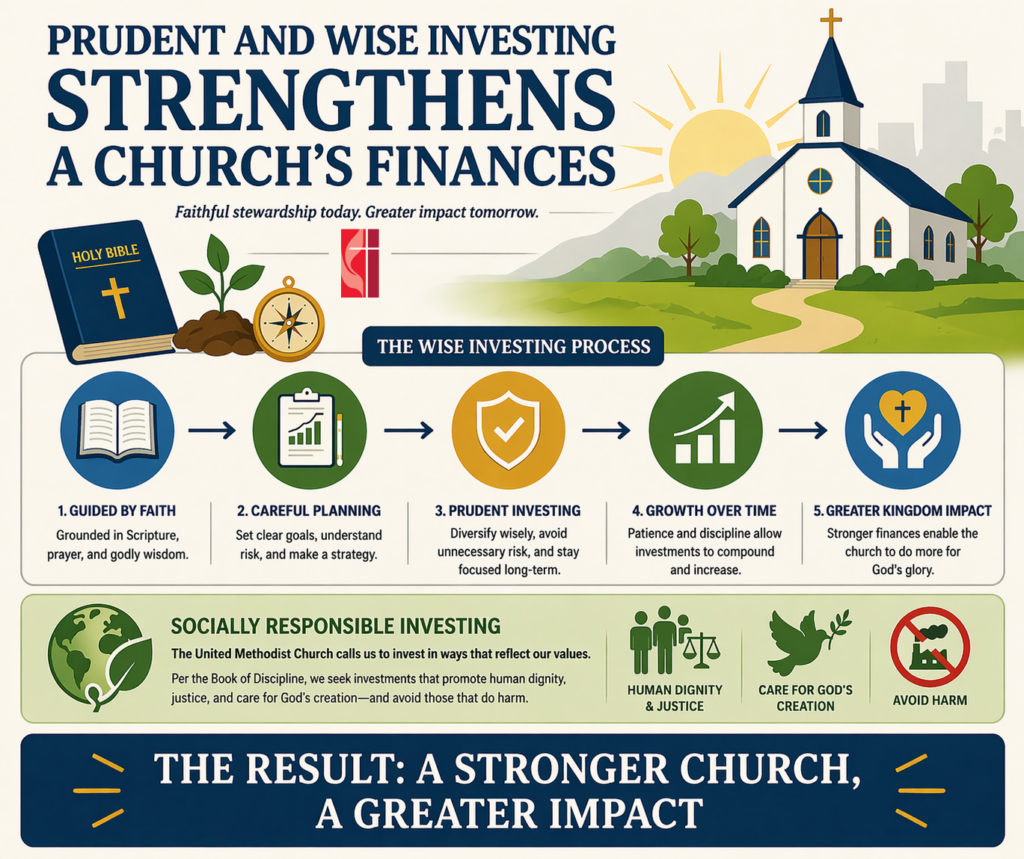
How the Virginia United Methodist Foundation Integrates Christian Conviction, Prudent Governance and Socially Responsible Investing
“The Church is called not only to use its resources faithfully, but to invest them faithfully, so that today’s stewardship strengthens tomorrow’s ministry.”
In the life of the Church, financial resources are never merely transactional. They are inherently missional. Financial resources support worship, discipleship, outreach, pastoral leadership, lay leadership, and the long witness of congregations seeking to serve Christ with integrity.
Stewardship Rooted in Christian Conviction
Because of this missional weight, the Virginia United Methodist Foundation approaches investing as more than portfolio management. It is a ministry of stewardship — a disciplined, fiduciary and distinctly Christian effort to help churches and other ministry partners preserve resources, grow them responsibly, and deploy them for faithful impact. The Foundation’s Investment Policy Statement (IPS) makes clear that our investment program is structured to protect assets, support the Foundation’s mission, provide prudent investment options, preserve purchasing power, maintain flexibility for spending needs, and conform as closely as possible to the socially responsible investment guidelines of The United Methodist Church.
For Christ’s Church, stewardship can never be separated from discipleship. Christians do not simply ask whether money is being managed efficiently, but whether it is being managed faithfully. In our Wesleyan perspective, financial resources are not ends in themselves, but rather gifts of generosity to be received with gratitude, governed with prudence, and directed toward the mission of making disciples of Jesus Christ for the transformation of the world.
At its best, Christian stewardship carries both proclamation and hope. We hold and manage these assets carefully because they do not belong to any individual or institution alone. They belong, in a real sense, to the work God is still doing through the Church. That conviction gives financial decision-making a pastoral weight, reminding us that prudent investing can also be an act of service to future generations of ministry.
Why Socially Responsible Investing Matters
The Foundation’s IPS explicitly states that funds are to conform as closely as possible to the socially responsible investment guidelines outlined in the Book of Discipline of The United Methodist Church. The IPS further requires that investment managers and advisors be directed toward those principles and that adherence be monitored as part of ongoing oversight.
That matters because values-based investing is not an optional investment strategy or a marketing methodology. It is a matter of institutional integrity. Churches increasingly recognize that their financial practices should align with their Christian proclamation. They do not want to advance ministry with one hand while unintentionally underwriting conflicting practices with the other.
The Virginia United Methodist Foundation offers congregations and ministries a way to invest with that holistic integrity. Our operational framework is built on the conviction that faithful stewardship includes both sound financial management and theological faithfulness.
Prudence Is Not Opposed to Faithfulness
Theologically grounded, wise investing should never be mistaken for financially casual investing. In fact, the Foundation’s IPS demonstrates just the opposite, reflecting a robust commitment to fiduciary discipline, prudent governance and long-term risk management.
The IPS outlines our formal governance structure involving the board of directors, investment committee, investment advisor, custodian and outside managers. Additionally, it affirms the fiduciary standards required under Virginia law and describes a clear framework for selecting managers, monitoring performance, managing asset allocation and reviewing policy over time.
The policy also identifies objectives that are both practical and mission-oriented: providing financial support for the Foundation’s mission, preserving the purchasing power of current assets and future contributions, achieving reasonable return objectives within prudent risk levels, retaining flexibility for distributions and liquidity needs, controlling costs, and aligning the funds as closely as possible with United Methodist socially responsible investment standards.
This is what faithful stewardship looks like in institutional form: clear objectives, disciplined oversight, a highly committed professional staff and board of directors, and decisions made for the long term rather than short-term reactions.
Investing for Ministry Across Generations
The Foundation’s IPS makes clear that our investment program is designed not only for present needs, but for enduring ministry. That long-view discipline is especially important for churches, endowments and ministry organizations. These are not institutions called merely to survive to the next quarter but to sustain witness over generations. The Foundation’s spending policy reflects that same mindset by balancing present support for ministry with the long-term preservation of strength for ministry yet to come.
A Range of Investment Options, Guided by Purpose
The Foundation’s investment program includes multiple portfolio options, each designed with a defined objective, allocation structure and risk profile. The IPS appendices identify four investment options: the Balanced Fund, Balanced Plus Fund, Stock Fund and Bond Fund. These options are not generic off-the-shelf products but part of a comprehensive, board-approved investment framework designed around the needs of churches, conference agencies and related ministries. This allows constituent investors to choose among prudent strategies while remaining within a system shaped by fiduciary rigor, moral values and world-class investment expertise.
The Strength of Connectional Stewardship
One of the clearest advantages highlighted in the Foundation’s investment summary is the power of investing together. The summary notes that larger combined investments create better access to institutional strategies, potentially stronger results, and lower costs than many churches could achieve on their own.
This is not only efficient but also deeply United Methodist. Connectionalism has long been one of the defining strengths of the Wesleyan life. We understand that a shared mission creates possibilities an isolated effort cannot. The same is true in stewardship. Through the Foundation, congregations can participate in a professionally managed investment structure that reflects both economies of scale and the Church’s shared witness.
Professional Management in Service to Ministry
The Foundation’s one-page summary notes that investment management is provided through Merrill Lynch, and the IPS identifies Merrill Lynch Pierce Fenner & Smith as the investment advisor and U.S. Trust as custodian in the key information section. The IPS also sets forth the advisor’s responsibilities, including helping maintain investment policy, selecting managers, overseeing asset allocation, monitoring performance, and supporting compliance with socially responsible investment expectations.
This kind of structure matters. It means churches are not being asked to choose between theological alignment and professional competence. They can have both. The Foundation’s model combines institutional-level investment management with a framework tailored to the specific needs and values of United Methodist ministry derived through rigorous, values-based analysis.
Low Fees, Higher Missional Capacity
The investment summary also emphasizes another practical advantage: fees never exceed 99 basis points or 0.99 percent. That detail is not small, as fees directly affect ministry capacity. Every dollar lost unnecessarily to cost is a dollar not available for community engagement, benevolence, staff support, facilities, scholarships, outreach and worship.
A disciplined fee structure, combined with pooled investment strength and institutional oversight, means more of each church’s resources remains available for the work that matters most. Good stewardship includes not only earning wisely, but spending wisely.
An Invitation to Invest with Integrity
In a time when many organizations separate financial decision-making from moral and spiritual identity, our Virginia Conference churches and ministry partners have an opportunity to demonstrate a better way. They can show that responsible investing and Christian witness belong together by choosing stewardship that is prudent without being detached, values-driven without being naïve, and professionally managed without losing sight of mission.
That is the invitation offered by the Virginia United Methodist Foundation. When churches and ministries invest through the Foundation, they are not simply seeking returns. They are participating in a disciplined, connectional and faithfully grounded investment ministry. They are choosing a model in which financial resources are managed with care, aligned with conviction, and directed toward the flourishing of Christ’s Church. They are working with staff who are highly accessible, focused on excellence, and passionate about meeting each ministry setting’s unique needs.
In a season when many congregations are asking how to remain faithful, fruitful and forward-looking through their adaptive leadership, this is one practical way to answer that call. We invite your church or ministry setting to invest with integrity.
If you would like to learn more about partnering with the Virginia United Methodist Foundation, please contact the Rev. Chris Allen, VP of Investments & Lending, at chrisallen@vaumc.org. We are here to help you navigate investing that aligns faith and financial fruitfulness.
Rev. Dr. Steven J. Summers
President & CEO